Site criteria
Copy wind speed, exposure, ground snow load, and seismic design category from the project. Leave blanks empty.
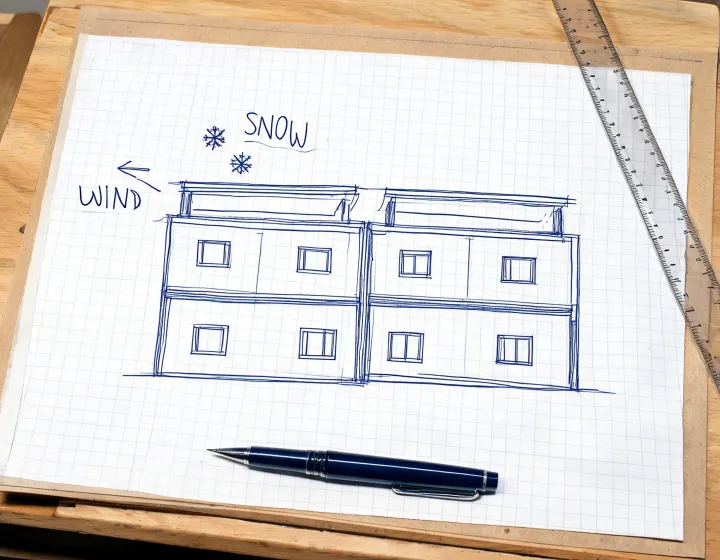
Loads
HarborSource Sourcing keeps this specification center on forces and scope, not on a sustainability pledge and not on a brand catalog. A willscot search may be why the file was opened. The building still needs its own wind speed, ground snow load, seismic design category, and floor loads.
The desk is not willscot, not a manufacturer or authorized dealer, and it does not stamp drawings.
Send Project RequirementsCopy wind speed, exposure, ground snow load, and seismic design category from the project. Leave blanks empty.
Separate design dead load and design live load. A storage use is not an office use.
Note primary frame, secondary framing, purlin, and girt if a steel system is offered. Module dimensions if it is volumetric.
Thermal transmittance, fire-resistance rating, and openings. An insulated metal panel sample is not the roof.
The buyer records which deviations stay. The desk does not close them by silence.
| Lateral and gravity | |
|---|---|
| Wind | Speed and exposure category, plus any topographic note the engineer already has |
| Snow | Ground snow load and whether drifting at a taller neighbor matters |
| Seismic | Seismic design category and the site class if it is known |
| Gravity | Design dead load, design live load, and concentrated loads from safes, racks, or a server row |
| Geometry that changes those loads | |
| Height | Eave height or interior clear height, and the number of stacked modules |
| Span | Clear span and bay spacing for a frame; module dimensions for a box |
| Openings | Door and window sizes that cut the wall diaphragm or the panel joint |
Volumetric modules carry more finish off site and a tighter transport envelope. Panelized construction can pack flatter and then asks the site to own alignment and weather. A standard bay is comparable only when the published geometry survives the load cases above. Custom engineering is the other path when it does not. Shell scope leaves the foundation interface and much of the MEP with the buyer. Turnkey scope still needs exclusions read line by line.
Cold-formed steel and hot-rolled steel are not interchangeable labels. Ask for the grade and the coating with the member size. AWS D1.1 is relevant when the offer includes structural welds; it is a document to request, not a credential of this desk. ASCE 7 is the usual US reference for the load criteria themselves, applied by the project engineer to the jurisdiction, not by a sourcing note.
Interior color can wait. Wind, snow, seismic, floor use, jurisdiction, quantity, and destination should not. A factory that prices without them is pricing a different building.
The system name on the drawing, the load cases in the calculation, the scope word on the commercial page, and the delivery point. A lower unit rate with a thinner roof deck is a change of specification, not a saving to publish.
No. Manufactured housing rules, modular building programs, and recreational-vehicle rules answer different buildings. Write the path the authority having jurisdiction actually uses.
Related reading sits on the product systems page. The form is on contact.
A partial criteria sheet is more useful than a guessed wind speed. Mark the currency and whether a budget is per unit or for the whole order. Mark high-end, mid-range, budget, or undecided if you have a preference. That mark is not a verified grade of any factory.
Eligible sourcing support may be available up to 3% after the brief is reviewed.
Eligibility applies to qualified business buyers and is confirmed after we review your product, quantity, destination, and sourcing requirements.
This note is not a fixed price cut, a quoted building price, or a supplier performance claim.
Submit procurement requirements